
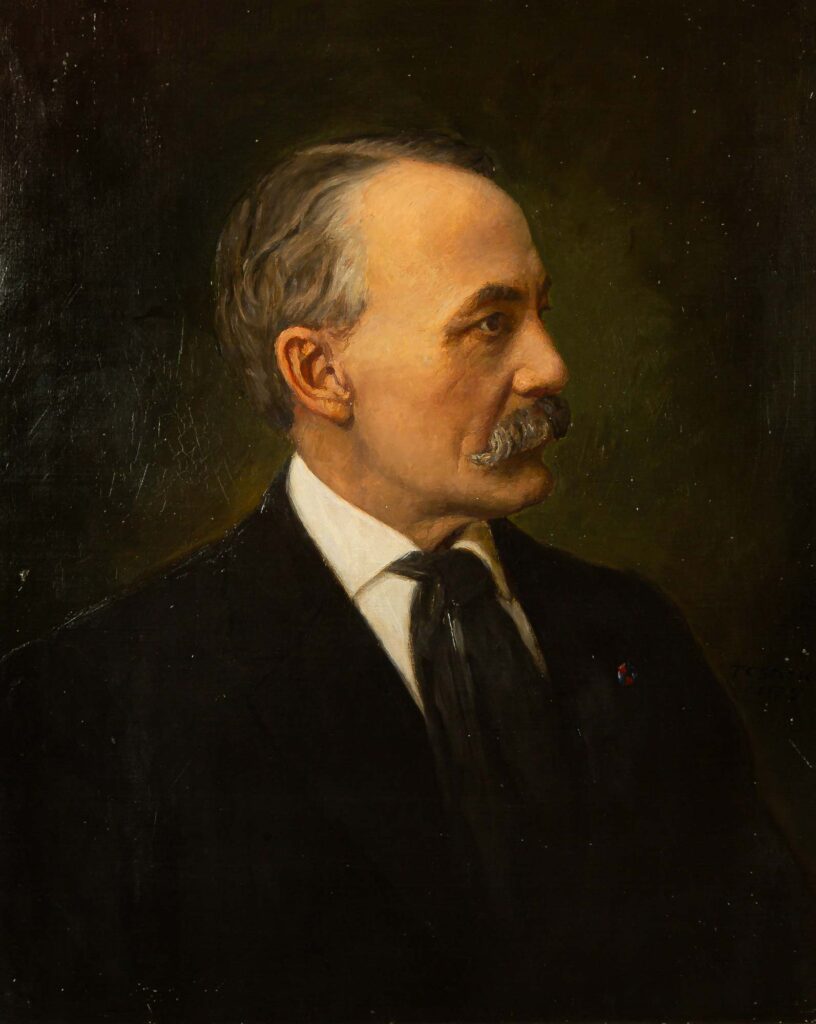
Theodore Clement Steele, American, 1847–1926
1905
Oil on canvas
67.31 cm x 54.61 cm | 26 ½ in x 21 ½ in
Framed: 96.52 cm x 85.09 cm | 39 in x 34 in
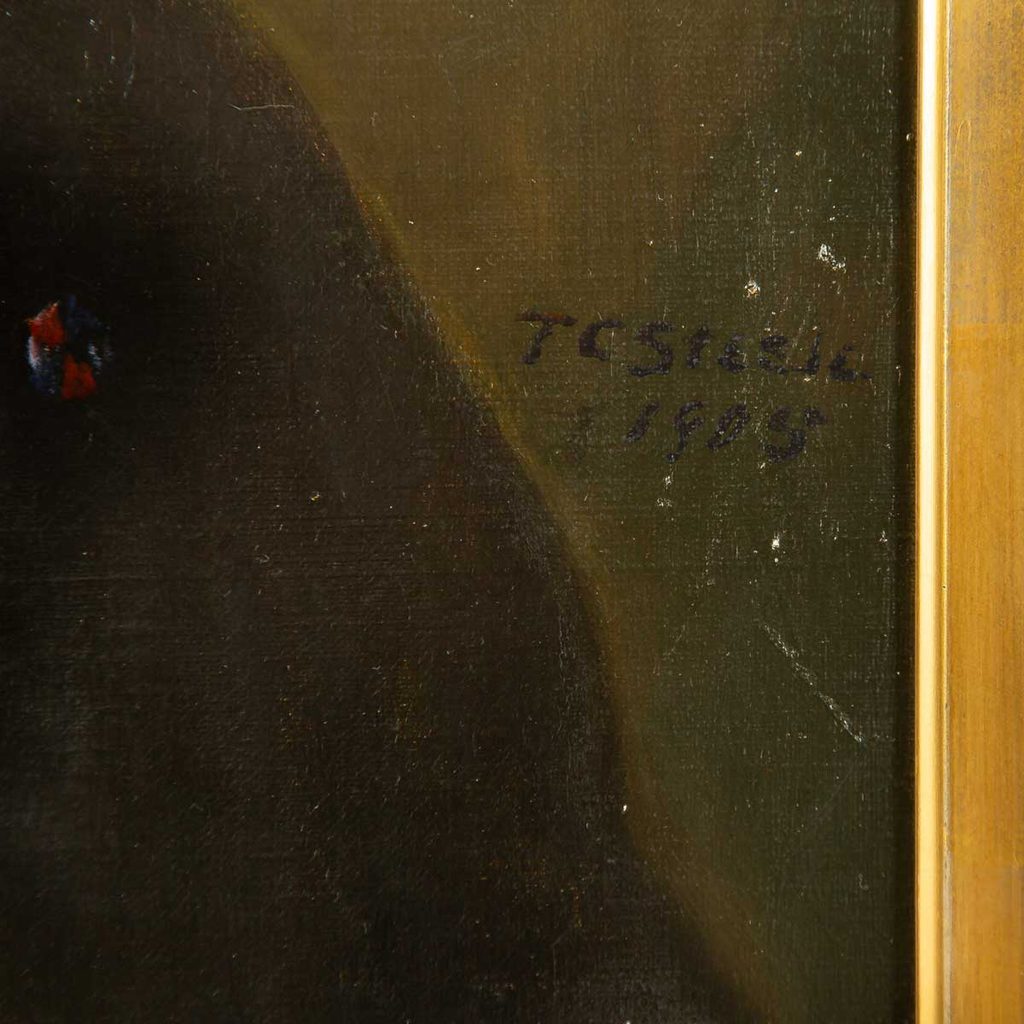
Signed and dated right, T C Steele 1905
Columbia Club Collection, Indianapolis, Indiana
Note: Portrait not available for public viewing.
Myron Winslow Reed (1836 -1899) was an American lawyer, Congregationalist minister and political activist. Born in Brookfield, Vermont, his father was also a minister. He would become known as the western United State’s foremost Christian Socialist, and demanded justice for Native Americans, women’s suffrage, and assistance for the poor.¹
He attended the St. Lawrence Academy in Potsdam, New York, and taught school for two academic years in Watertown, Wisconsin studying law in the evening. He was admitted to the Wisconsin state bar in 1860. Reed did not feel himself drawn to the legal profession, and at the urging of friends he left for Chicago to enroll at the Congregational theological seminary there.
With the outbreak of the Civil War, Reed put aside his theological studies and enlisted as an officer serving in the Union Army. He was wounded in acion in Tennessee and damage done would afflict Reed the rest of his life. After his service in the Union Army, Reed resumed his religious studies, at the Chicago Theological Seminary.
From his first Congregationlist pastorate in Hudson, Michigan, Reed’s reputation as spellbinding and thoughful divine grew, and he was called to Frist Presbyterian Church in Indianapolis, Indiana. US President Benjamin Harrison and his wife Caroline were among its members.
After seven years at First Presbyterian Church, he moved to become pastor at First Congregational Church of Denver, Colorado.
He was one of the leading Christian socialists in the American West and ran for U.S. Congress, as a democrat in 1886, but was not elected. He was co-founder of Denver’s Associated Charities which evolved into the United Way.


L-R: Plate located center of frame bottom reads Myron W. Reed, 1879-‘80; Plate mounted on wall next to painting reads: Myron W. Reed, 1836-1899, Minister First Presbyterian Church, Fourth President, Indianapolis Literary Club (1879 – 1880), T.C. Steele, 1905, Oil on Canvas, On Loan from the Indianapolis Literary Club
Reed died in January of 1899, after suffering from an illness that began early in the same month. Reed was 62 at the time of his death.
Colorado Governor Charles S. Thomas arranged for his body to lie in state at the Colorado State Capitol prior to internment.
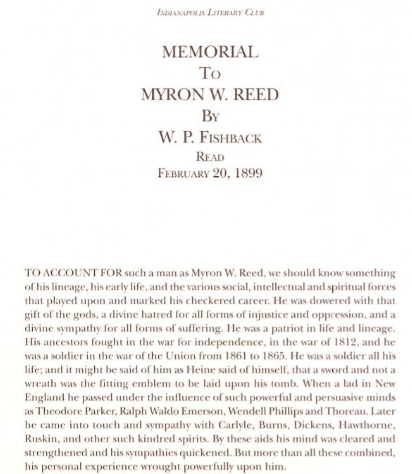
Below is an excerpt “Memorial to Myron W. Reed” read by William P. Fishback to the Indianapolis Literary Club on February 20, 1899. He died the previous month on January 30, 1899.
The Columbia Club
The Columbia Club was established in 1888 as the Harrison Marching Society to support the candidacy of General Benjamin Harrison of Indianapolis as President. After Harrison won election in that year, the society decided to incorporate as a permanent organization and chose the name Columbia Club, based on the popular alternative name for America at the time.
The Club has occupied three buildings at its prominent location on Monument Circle, and the current building opened in 1925. Designed in English Tudor style by the noted Indianapolis architects Rubush and Hunter and features lavishly appointed interiors with sculptures and plaster details by top Indiana artists.
The present building has hosted famous personalities and holds a tradition of important business and civic meetings being held at the club.
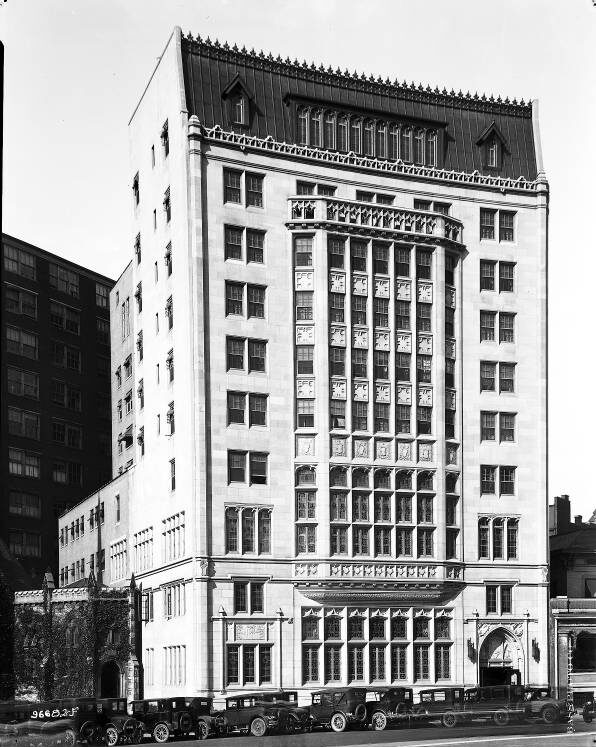
In 1926, Queen Marie of Romania was welcome to the city with a banquet at the Club, and the next year Charles Lindberg, the American Eagle, was honored at the Columbia Club for flying solo from New York to Paris.
In 1976, President Ronald Regan keynoted the annual Beefsteak Dinner held since 1891.
In the previous clubhouse the four founders of the Indianapolis 500 – Carl Fisher, James A. Allison and Arthur C. Newby met in 1909 at the Club and discussed building the Indianapolis Motor Speedway. In more recent years, the agreement to bring the Baltimore Colts to Indianapolis was finalized at a meeting in a Columbia Club suite.3
T.C. Steele was a member of the Columbia Club during the time he and his family lived in Indianapolis at Tinker Place (1885 – 1901).
The Columbia Club was added to the National Register of Historic Places in 1983.
Footnotes
Special Thanks to The Columbia Club
1 Encyclopedia of the Great Plains, James A. Denton, University of Colorado at Boulder
2 Indiana Historical Society, W.H. Bass Collection 1925